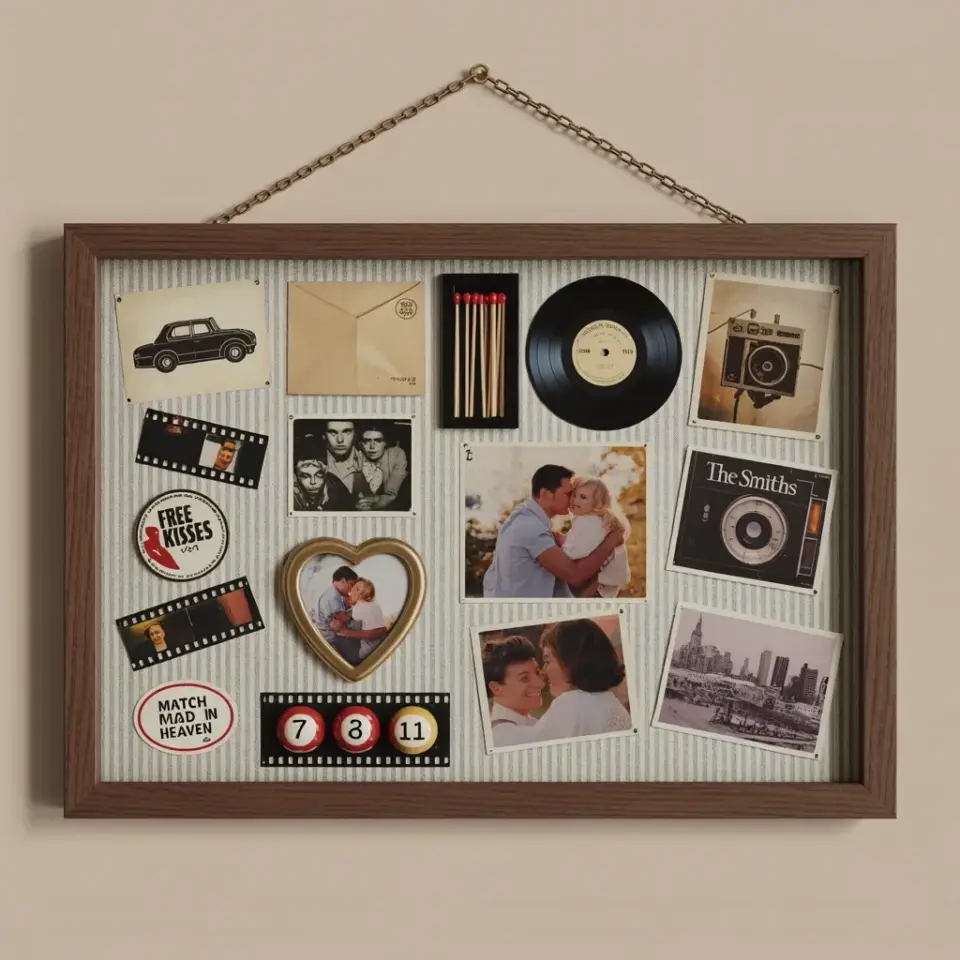
The frame went up on a Tuesday, and the hallway hasn’t been the same since. This memoryboard took me one afternoon and a shoebox full of things I’d been saving for no real reason. It hangs on a beige wall in a dark brown wooden frame, backed with gray and white striped wallpaper that I dug out of a free box. Inside: a black car illustration, a postcard envelope, matchsticks, a vinyl record, a vintage camera photograph, a Smiths album cover, a heart-shaped locket, film strip negatives, a “free kisses” sticker, two red pool balls numbered 7 and 11, and a matchbox stick that says “Match Made In Heaven.” Sounds like junk. Looks like art.
The best part? Almost none of it was bought new. That’s what sold me on this whole retro wall art idea. You don’t need a curated collection or a trip to the craft store. You need a frame, a background, and the courage to tape random things to a board.
What went into this memoryboard
I laid everything out on the floor first, just to see what I was working with. The Smiths album cover was the anchor, obviously. It’s the *The Queen Is Dead* cover, which is moody and perfect for this aesthetic. I placed it slightly off-center because the red pool balls needed room on the other side. The 7 and 11 balls are shiny and heavy, so they got glued with extra strength adhesive. Matchsticks went into a neat row along the bottom, giving the whole piece a bit of texture. The film strip negatives were tucked into a corner like an afterthought, but they ended up being the thing people notice first.
The heart-shaped locket was the last piece I added. Honestly, I almost skipped it. But a locket in a collage acts like a tiny secret. You don’t have to open it, but you know there are photos inside. That alone makes the whole memoryboard feel more personal.
Hunting for found objects without forcing it
Look, the easiest way to find things for a vintage collage is to stop looking. I keep a drawer where old tickets, postcards, and random papers just land. When I started this project, I dumped the whole drawer onto my desk and picked out only the things that had some visual weight. The black car illustration came from a 1970s car magazine. The postcard envelope was empty, but the postmark was from 1988, so it stayed. That’s the rule for retro decor: if it has a story, even a half-forgotten one, it earns a spot.
One thing I learned is to avoid scrolling through vintage shops online for too long. You’ll end up with a pile of stuff that expects to be arranged a certain way, and that kills the spontaneity. Instead, ask your parents or older friends if they have any old correspondence or magazines. People love giving away things they were about to throw out. My matchsticks came from a café that still gives out paper matchbooks. I asked for a handful and the waitress just stared at me. I told her it was for art, and she brought me two whole boxes.
Putting the vintage collage together in one afternoon
This is not a project that needs a detailed plan. I placed the wallpaper inside the frame first, then started laying objects on top without glue. I moved the Smiths cover to three different positions before settling on the lower left. The camera photograph went above it, slightly tilted. The vinyl record, a scratched 45 of some song I don’t even remember, leaned against the edge of the frame like it was resting. That casual lean is what makes it feel old and lived-in.
Use a dab of hot glue for paper and a stronger adhesive for anything with weight. The pool balls needed a few minutes of pressing down before they stayed. The locket had a hinge on the side, so I glued the back flat against the wallpaper. I also added a couple of matchsticks as a border around the top right, just to balance out all the rounded shapes. Here’s what I used, in case you want to copy the approach:
- Gray and white striped wallpaper remnant (or any bold pattern)
- Old album cover or sheet music
- Two or three heavy objects like pool balls or wooden letters
- A locket, preferably with photos already inside
- Film strip negatives or old receipt rolls
- Matchsticks or paint stirrer sticks for texture
- A postcard envelope or vintage stamp
The “Match Made In Heaven” stick was pure luck. I found it in a jar of buttons and random hardware. It’s the kind of phrase you can’t design yourself, so it felt like a gift. I glued it running diagonally across the corner of the envelope.
Using a locket in wall art without it looking cheesy
Lockets can easily tip into costume jewelry territory. The trick is to keep it small and let it blend in, not become the centerpiece. I used a brass heart-shaped locket that had tarnished a little. The photos inside are tiny black-and-white prints, one of my grandmother and one of a dog I don’t recognize. The dog is the best part. Nobody knows who it is, but everyone asks.
I placed the locket near the center of the board, right where the eye lands after scanning the pool balls. That way it feels like a reward for getting closer. If you can find a locket that opens, leave it open just a crack. The hint of a photo makes people lean in. If it’s permanently sealed, that’s fine too. It still reads as a nostalgic object.
You don’t need a real vintage locket either. Thrift stores often have broken ones for a dollar or two. Even a modern one, if you sand the shine off and add a bit of dark patina, will look like it survived decades. I gave mine a quick wipe with a damp cloth and let it air dry. The tarnish actually helped.
Framing and hanging a DIY memory board
The frame I used is dark brown wood, roughly 16 by 20 inches. I bought it at a garage sale for five dollars, and it already had a hook on the back. That’s the easiest way to go. A deep frame gives you room to layer objects without shooting things out of the front. My frame isn’t deep, so I had to keep everything flat. Pool balls are tall, but with a small dab of glue they stayed put.
I hung it on a beige wall with a single picture hook rated for fifteen pounds. The whole collage weighs about three, so that’s overkill, but better safe than picking glass shards off the floor. Before hanging, I placed the framed piece on a chair and stepped back to check the balance. The left side had the Smiths cover and the camera photo. The right side had the pool balls and the car illustration. The middle was lighter, so I added the “free kisses” sticker and the film strip negatives to fill that gap.
Measure about 57 inches from the floor to the center of the frame. That’s the standard gallery height, and it works for most hallways. But honestly, if you’re hanging it in a breakfast nook or above a low bookshelf, just eyeball it. My hallway has a weird slanted ceiling, so I hung it slightly higher on one side. Nobody has ever noticed except me.
Why retro decor needs a little weirdness
If this board had been neat and perfectly balanced, it would’ve looked like a store display. The weirdness makes it real. The red pool balls are too shiny for a vintage piece, but they work because they’re unexpected. The “free kisses” sticker is half peeling off, and I left it that way. That’s the kind of small flaw that keeps it from feeling stiff. Retrodecor should feel like a collection of accidents that somehow got along.
I almost removed the black vinyl record because it covers part of the Smiths cover. But leaving it there forces you to look closely and piece together the layers. That’s the point of a memoryboard collage. It’s not a poster, it’s a pile of stuff with a point of view. You can do the same with whatever you’ve got. A worn-out ticket stub from a band you don’t even like anymore. A broken watch face. A map of a city you visited for exactly one day.
The thing that surprised me most was how quickly it came together. I expected to overthink every placement and rearrange everything a hundred times. Instead, the first arrangement worked about ninety percent. I moved the postcard envelope two inches and swapped the camera photo with the negative strip. That was it. Sometimes making a decision and sticking with it is the best way to get the project done.
I’ve hung a lot of art over the years, and this memoryboard gets more comments than anything else in the house. People stop and look at the locket. They ask about the pool balls. They want to know where the Smiths cover came from. Every single person has a different favorite piece, and that tells me the collage is working. It’s not about perfect composition or a expensive frame. It’s about giving objects a second life and letting them share a wall without explaining themselves.
If you have a shoebox of old photos and a few curious odds and ends, try this over the weekend. It’s a slow, satisfying project that doesn’t require any special skills. Just gather what you love, frame it, and let the weirdness show. You might surprise yourself.
Leave a Comment