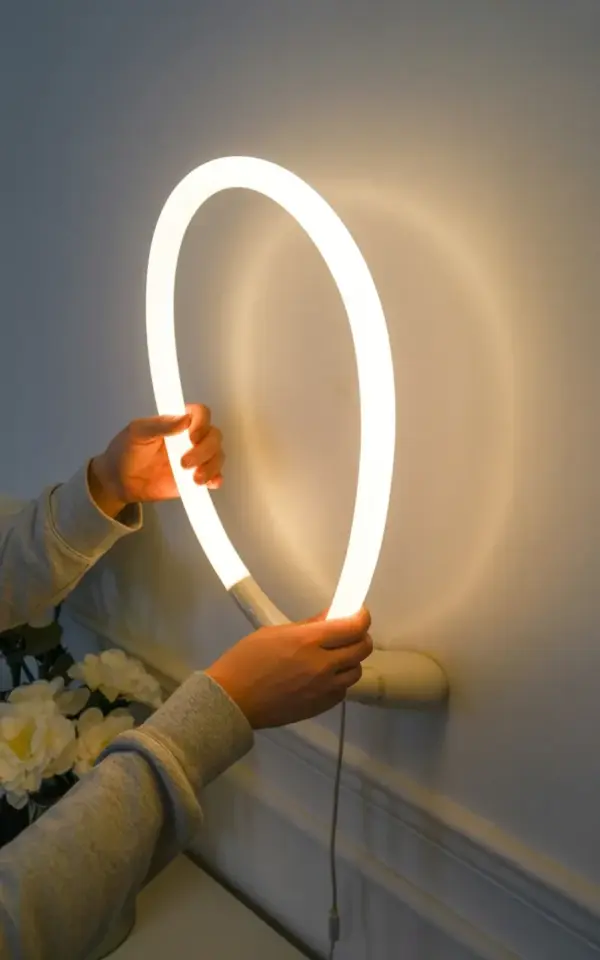
There is something hypnotic about a close-up shot of fingers adjusting a bendable neon tube. In the image that sparked this article, a white LED neon light makes a smooth S-curve against a soft gray wall, radiating that buttery, warm glow that instantly makes a room feel like a safe place to exhale. The long sleeves, the white flowers peeking into the corner, the subtle shadow play, it all adds up to a vibe, not just a light fixture. This is exactly the kind of **neonsign** moment that makes you stop scrolling and think, “I need that in my life.”
But a custom neon sign doesn’t have to be a mystery. Honestly, it is one of the most practical, straightforward home decor projects you can tackle on a weekend. Whether you want a single letter, a wave, or a full word, the process is the same. Let me walk you through the actual steps of making this exact S-curve aesthetic work in your own home, from ordering to mounting to that perfect cozy glow.
## Why a curved LED neon sign beats a straight one
A straight line is fine for a garage or a commercial storefront, but it lacks personality. In a living space, you want movement. The S-curve works so well because it draws the eye in a soft, organic path. It feels less like signage and more like sculpture. When the light bends, it creates pockets of shadow and brightness on the wall behind it, which is more interesting than a flat, uniform line. You get that dimensional, close-up effect you see in the photo, where the tube is clearly floating slightly off the wall, casting its glow outward.
Curves also give you more flexibility with placement. A straight sign needs to be perfectly level and often looks rigid. A curved piece can sit on a console table, lean against a shelf, or hang above a bed without feeling too formal. Plus, the actual bending process is part of the fun. Watching a custom manufacturer shape the **ledneon** based on your sketch is genuinely satisfying. You realize you are not just buying a product; you are commissioning a small piece of light art.
## Buying custom neon: what to decide before you order
Before you hit “checkout”, you need to make three specific decisions about your **customneon** piece. Do not skip this step, because getting it wrong means a return shipping headache and a lot of wasted time.
– **The backing material**: Clear acrylic is invisible, so it looks like the light is floating. A colored backing adds contrast but can feel heavier.
– **The color temperature**: Pure white can feel clinical. Warm white gives you that honeyed, intimate mood seen in the reference photo. Choose warm white if you want cozy.
– **The power source**: Battery packs are great for portability but need charging. Plug-in units are boring but reliable for a permanent wall piece.
Here is a tip I picked up from a lighting installer I interviewed last year: order a slightly larger sign than you think you need. A small **neonlight** on a huge empty wall looks like an afterthought. You want it to have presence. Most shops will give you the exact dimensions before production, so tape out that size on your wall with painter’s tape first. It helps you visualize the scale without committing to drilling holes yet.
## How to hang a custom neon sign without ruining your wall
The mounting process is easier than most people assume, but you do need to plan. Most LED neon signs come with a clear acrylic backplate that has pre-drilled holes. You are not sticking the tube directly to the paint, which is a relief. The cleanest method is to use small, clear plastic standoff spacers. These little screws hold the sign about 10mm off the wall, which creates that beautiful halo effect you see in the photo where the light blooms outward.
You will need a drill, a level, and a pencil. Mark your holes, drill pilot anchors into the drywall, and screw in the standoffs. A note for renters: look for damage-free mounting hooks or heavy-duty adhesive strips rated for the weight. They work better than you would expect on a smooth, painted wall. If your wall has a textured finish like orange peel, skip the adhesive entirely. It will peel off within a month, and you will be holding a broken sign. Use screws, or find a different spot.
## Getting the glow right: placement tricks for cozy light
The wall color matters more than you think. In that inspiration photo, the gray wall is doing a lot of heavy lifting. A mid-tone gray absorbs some of the light rather than bouncing it back harshly, which softens the whole scene. If you place a warm white sign on a stark white wall, the glare can be intense. You want a surface with a bit of texture or a darker paint color to create that intimate, close-up atmosphere.
Positioning is about eye level and purpose. For a reading nook, place the sign around 60 inches off the floor, slightly off to the side so it washes light over your shoulder. For a shelf display, let it sit behind objects like books or vases to create layered shadows. The partial view of white flowers in the bottom corner of the photo is a styling cue, not an accident. Pairing hard light with organic shapes like plants or flowers makes the neon feel approachable rather than techy.
## How to style a custom neon sign like it belongs
The number one mistake people make with **homedecor** neon is treating it like a glowing advertisement. They hang it in an empty room and call it a day. Instead, build a vignette around it. Use the natural focal point to anchor a small table, a stack of books, or a low plant stand. The light will naturally highlight whatever you put below it. In the photo, the fingers adjusting the tube draw your attention to the act of creation, so think about how you want people to interact with your sign. Do you want them to walk up and touch it? Then use a flexible tube and let them bend it. Do you want it as a backdrop? Keep it flat on the wall and style the space in front.
Here is a slightly weird but effective thought: match the mechanical rhythm of the room to the curve of the sign. A strict, angular sofa with sharp lines might fight against a flowing S-curve. A soft, rounded armchair will echo it. It sounds neurotic, but it works. Your eye picks up on those subtle repetitions. If you want a high-end designer feel, let the neon echo other curves in the room, like a round mirror or a curved floor lamp. Consistency in shape makes the room look intentional.
## My honest take on LED neon vs traditional glass neon
Ok so, let me quickly destroy a myth. Traditional glass neon looks incredible, but it is fragile, expensive, and uses high voltage. The average rental apartment is not suitable for it. Luckly, LED neon gives you 90% of that visual magic without the nightmare of shipping a glass tube across the country. The bendable silicone housing feels like a thick wire, it is completely flexible, and you can reshape it occasionally. We swapped out a flickering glass sign in our home office two years ago for a white **ledneon** piece and never looked back. The light is more consistent, it runs cool to the touch, and I do not worry about my cat knocking it over and shattering glass everywhere.
Is it exactly the same as gas-filled glass? No. The light quality is slightly more diffuse, and the tube is thicker. But for a cozy, intimate home setting, it is the better tool. Glass neon belongs in galleries and vintage diners. LED neon belongs in your bedroom, where it can cast that radiant, soft heat-like glow without being a safety hazard. I would also point out that LED ribbons are more energy-efficient. Running a three-foot sign for a full year costs less than a fancy coffee, which is a nice perk.
## Final thoughts on your own neon light project
That S-curve in the photo is not just a decorative detail. It is a low-key invitation to experiment with light in a way that feels personal. Grab a sketchbook, draw a shape that means something to you, and send it to a reputable custom shop. The process is shockingly fast, usually two weeks from design to delivery. When you unbox it and plug it in for the first time, you will understand why these have taken over the **homedecor** scene. It is not about the gadget, it is about the mood shift.
If you are still on the fence, start small. Order a simple bend or a single initial to test the waters. Hang it in a corner where you drink your morning coffee or read before bed. Then stand back and watch how the light changes the temperature of the room. Go ahead, treat yourself. Your wall has been waiting for a little glow.
Leave a Comment