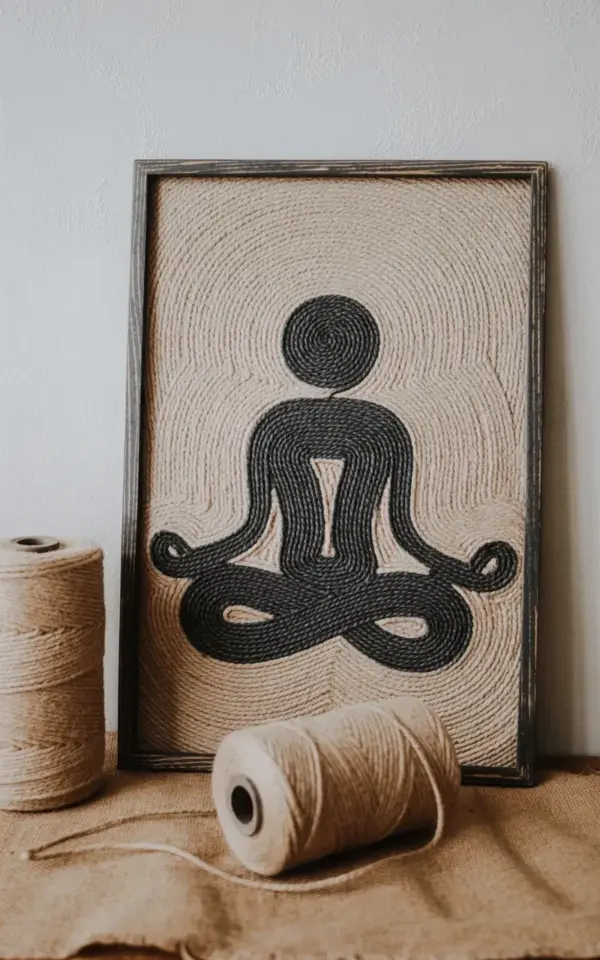
That first coil of black jute can feel intimidating when it’s sitting in your hands. You see the finished piece, that serene meditating figure with the flowing spiral robe, and you wonder how a simple rope can make something look so calm. But honestly, the process is more forgiving than you think. This zen rope wall art project is a perfect weekend build, and it costs a fraction of what a boutique store would charge for the same rustic jute twine decor.
The photo that started this whole idea for me shows a minimalist figure, all black rope on a textured beige background. It’s mounted in a dark wooden frame, and the whole thing just breathes calm. I had two spools of natural jute twine sitting on a burlap surface in my own craft room, and a light gray wall begging for something meaningful. So I figured it out, and now I’m showing you exactly how to do it.
Gathering Your Materials for Jute Twine Wall Art
You don’t need a lot for this. That’s the beauty of working with rope; the materials are heavy on texture and light on cost. For the base, grab a rustic wooden frame with a flat backing, something dark to make the beige and black pop.
You will need the following supplies:
- One roll of black cotton rope or jute, around 3mm thick.
- A spool of natural jute twine for wrapping the frame or adding accents.
- Hot glue gun with plenty of sticks, this is the backbone of the project.
- Scissors or a sharp craft knife.
- Beige linen or canvas fabric to cover the frame’s backing board.
I used the natural jute spools from the photo just as props initially, but they ended up being perfect for testing the rope thickness. A thinner rope is easier to bend into tight curves, but a thicker one shows up better from a distance. Go with 3mm for the figure itself. It’s a nice middle ground.
Preparing the Textured Beige Background
Take your beige linen and lay it over the backing board with a little overhang. Pull it tight, really tight, and fold it over the edges before securing the backing into the frame. This part feels a bit like upholstering a dollhouse couch, but it’s the foundation for the whole look.
If you want that rustic, earthy aesthetic seen in the reference photo, skip the bright white fabric. The subtle texture of natural linen or burlap makes the black rope look softer and more organic. A textured background also hides small glue marks that might sneak out from under the rope.
Once the fabric is in place, set the frame aside for a minute. Just let the glue dry completely and ignore how tempting it is to start coiling the rope immediately.
Creating the Spiral Pattern for the Zen Figure
This is where the magic happens. The meditating figure in the photo is basically a series of spirals and flowing lines. Start with the head, a small, loose spiral at the top center of your canvas. Then move down to the shoulders.
Take your black rope and create a circular spiral for the head, leaving a tiny gap between each ring. Apply glue to the back of the rope in short sections, about an inch at a time. Don’t glue the entire coil at once or you’ll lose control of the curve and end up with a lopsided mess.
For the shoulders, you want the spiral to widen out and break open. Instead of a perfect circle, let the line extend outward to form an elegant, flowing curve on either side. This creates the silhouette of crossed legs in a lotus position using just one continuous line. It’s a clever little trick that reads instantly as “meditation” without looking childish.
Forming the Meditating Figure in Lotus Position
Here is the part that people will stare at when they hang it on their wall. The legs are the hardest to fake with rope, so we cheat by using swooping arcs. After you form the shoulders, loop the rope down towards the base of the canvas, then curl it back up like a reverse wave.
Compare it to drawing a lowercase “m” with a paintbrush. The two peaks of the “m” become the knees, and the valley in the middle grounds the body. Keep the loops wide and relaxed, you want it to look like fabric folds, not tangled cables.
A tiny personal tip here: I always mess up the transition point between the torso and the legs. To fix this, I tuck the end of the rope under another coil and glue it down so there is no visible blunt end. It takes two seconds, but it makes the whole piece look professional instead of like a craft experiment.
Mounting Your Rope Art in the Wooden Frame
Once you are happy with the spiral design, it is time to seal it inside that dark wooden frame. Carefully place the glass or the clear acrylic sheet back over the art if your frame has one, but for this style, I actually prefer leaving the glass off. The shadow cast by the rope adds a depth you lose behind any cover.
If you do skip the glass, make sure the rope is pressed down firmly and flat against the beige background. You don’t want it peeling up in the middle of summer heat. Use a flat weight, like a stack of heavy books, and let it sit overnight for the glue to cure.
The frame in the photo has that dark, almost walnut color, which creates a striking boundary against the light gray wall. It stops the earthy artwork from blending entirely into the wall and makes the black rope stand out.
Styling the Rustic Aesthetic on Your Wall
So you have the art finished, now where does it go? This zen piece thrives on contrast. Hang it against a light gray wall like the one in the original photo, or a crisp white wall if you want a more modern feel. Avoid putting it next to super vibrant colors; it will clash.
To complete the earthy aesthetic, place a few small props nearby. A spool of jute twine on a shelf underneath the frame or a small potted eucalyptus branch can tie the whole corner together. Just don’t overcrowd the wall, this art needs breathing room to feel peaceful.
Use a nail that sits flush with the wall so the frame hangs perfectly straight. There is nothing worse than a meditation symbol hanging crooked; it defeats the entire purpose of the calming energy.
Honestly, at the end of the day, this project is less about perfection and more about the process. Winding that rope into a spiral forces you to slow down, and the result is a handmade piece of zen rope wall art that feels uniquely yours. Soften your space with these neutral tones and try it out.
I would love to see how your meditating figure turns out. Tag a friend or share a photo of your completed rustic jute twine decor, I bet it looks fantastic on your wall.
Leave a Comment